
An initial aim of all microbiologists is the reproducible growth of their microbial cultures, no matter whether the microorganisms are of natural origin or have been genetically engineered by man. Reproducible growth requires defined environmental conditions with respect to energy source, temperature, pH and nutrients (see chapter Microbial Growth Requirements). With this in mind Fluka supplies a range of products and services (see list of culture collections, comparison of media etc.) designed to meet the needs of general microbiologists and specialists alike.
Microorganisms
In the group of organisms classified as microorganisms, there are simple unicellular forms (cocci, bacilli, virio and spirillae) as well as multicellular forms (filaments and sheaths). The group includes the blue green algae (cyanobacteria), fungi, protozoans and bacteria.
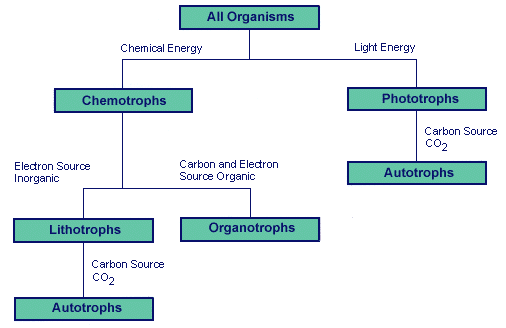
In order to survive and grow, microorganisms require a source of energy and nourishment. Bacteria are the most primitive forms of microorganisms but are composed of a great variety of simple and complex molecules and are able to carry out a wide range of chemical transformations. Depending on their requirements and the source of energy used they are classified into different nutritional groups.
The size of microorganisms varies from a fraction of a μm for viruses, which can only be seen in the electron microscope, to several cm for filamentous algae or fungi, for example:
| Organisms | Size range (μm) | Example (size in μm) |
|
| ||
| Prokaryotes | ||
| Bacterium: typical rod | 1.0-0.5 x 1.0-10 | Pseudomonas aeruginosa (1.5 x 0.5) |
| Bacillus megaterium (7.6 x 2.4) | ||
| Bacterium: typical sphere | 1.0 diam | |
| Eukaryotes | ||
| Fungi: filamentous | 8-15 x 4-8 | Mucor hiemalis (8 diam) |
| Fungi: yeast cell | Saccharomyces cerevisiae (29-49.1 μm3) | |
| Alga | 28-32 x 8-12 | Chlamydomonas |
| Viruses | ||
| Virus | 0.015 x 0.3 | Poliovirus (0.03 x 0.03) |
| Tobacco mosaic (0.02 x 0.3) | ||
|
| ||
Microbial Growth Requirements
Microbial growth requires suitable environmental conditions, a source of energy, and nourishment. These requirements can be divided into two categories, physical and chemical.
Chemical Factors
Table of the elements required for microbial growth as found in nature compared to the chemical forms supplied to microbiological media.
| Requirements for Growth | Form usually found in Nature |
Chemical Form commonly added to Microbiological Media |
|
| ||
| Carbon | Carbon dioxide (CO2), HCO3- organic compounds |
Organic; simple sugars e.g. glucose, acetate or pyruvate; extracts such as peptone, tryptone, yeast extract etc. Inorganic; carbon dioxide (CO2) or hydrogen carbonate salts (HCO3-)* |
| Hydrogen | Water (H2O) organic compounds |
|
| Oxygen | Water (H2O), oxygen gas (O2), organic compounds |
|
| Nitrogen | Ammonia (NH3), nitrate (NO3-) organic compounds e.g. amino acids nitrogen gas (N2) |
Organic; amino acids, nitrogenous bases Inorganic; NH4CI, (NH4)2S04, KNO3, and for dinitrogen fixers N2 |
| Phosphorus | Phosphate (PO43-) | KH2PO4, Na2HPO4* |
| Sulphur | Hydrogen sulphide(H2S), sulphate (SO42-), organic compounds e.g cysteine |
Na2SO4, H2S |
| Potassium | K+ | KCI, K2HPO4* |
| Magnesium | Mg2+ | MgCI2, MgSO4 |
| Calcium | Ca2+ | CaCI2, Ca(HC03)2* |
| Sodium | ||