
There are now standard techniques for introducing neurones into the brains of animals. Neurones are taken from an early embryonic rat brain, for example from that part of the brain that degenerates in Alzheimer's Disease. Further purification of these then occurs using various cell sorting techniques. Finally just the specific class of neurones required are placed in a tube from where they are sucked up into a pipette (see figure 14). This pipette is then used to inject the neurones into just that part of the brain which has degenerated or been injured (figure 14).
How do we test out if we have reconstituted normal function after say a transplant into the hippocampus of a set of neurones to replace those that have degenerated? Figure 15 shows one procedure that is used to determine this. It is called the alternating T-maze test. A rat is put at the end of one arm of the T-maze and is allowed to run to the other end where a choice is made of either turning left or right. In the first trial food is placed on the right arm and the rat is forced to turn right because a trapdoor prevents it from turning left. On the second trial there is no trapdoor to force the rat to turn a particular way so tha it may now turn either left or right. However a nasty trick is carried out before this second trial. Before the rat is allowed to run the second trial food is placed on the left arm of the maze, opposite its original position. After this trial the rat is taken out of the maze and allowed to rest for a while before another alternating trial is attempted. Altogether this is repeated about six times a day. It doesn't take very long before the rat appears to figure out what is going on. It turns right on the first trial and gets the food; on the second trial, when you put the food on the opposite arm, the rat immediately turns left and doesn't make the mistake of turning right. The graph in figure 15 shows the rate at which the rat learns to make the correct choice on the second trial, namely to turn left. In a sham trial the neocortex is exposed without any experimentation, and then closed; over a period of about one and a half weeks the rat learns on 100% of occasions to always turn left to get the food on the second trial. If however there has been an injury to the septum, then the rat turns left on the second occasion at random frequency (namely on 50% of the occasions). It hasn't learnt at all; it cannot lay down the memory that it should turn left always on the second trial. But if we do a transplant of healthy septal neurones from an embryonic rat into the hippocampus of this injured adult rat or of a rat whose septal neurones have degenerated because it has a form of senile dementia, then it only takes a matter of about two months before we find that the rats can learn at the 90% level to turn left (figure 15). The rats that received the transplant have learnt to nearly always turn left on the alternate tmaze performance because normal hippocampal functioning has been reconstituted by this septal transplant.
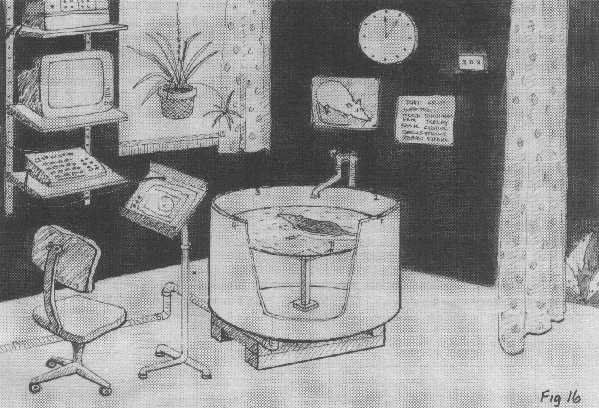
You might well ask how is it that the rat can tell where it is in the T-maze because the maze is symmetrical; how can the rat tell its left from its right despite the fact that it has no visual clues to orientate itself. Well the trick here is that the t-maze is set in a room which has lots of interesting objects in it and these allow the rat to work out exactly where it is. These interesting objects may include curtains, clocks, and pictures of female rats as shown in figure 16. This allows the rat to determine, when it is sitting at the start position n the T-maze, the geometry of the situation around it. The hippocampus calculates the spatial layout of the room from this information, allowing the rat to determine what is its left and its right. These spatial clues are very necessary for it to be always able to distinguish left from right in the alternating T-maze performance.
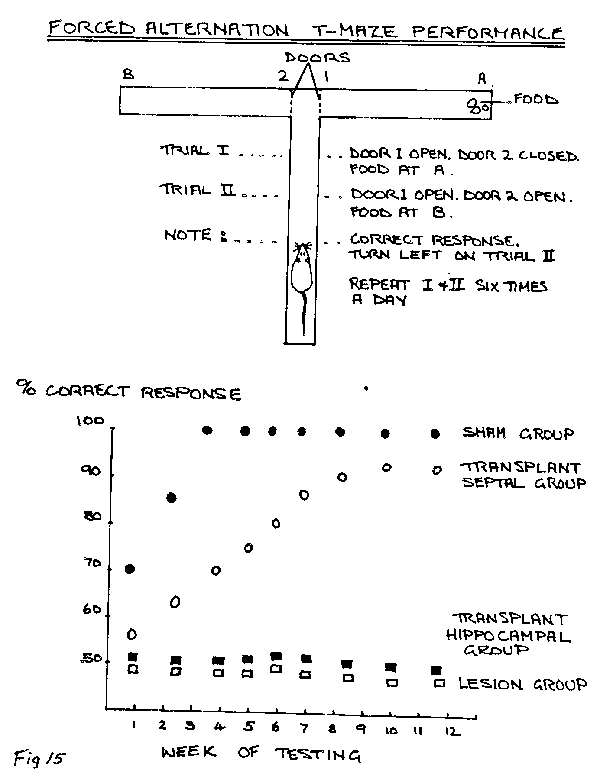 |
Figure 15. [Click image to enlarge] Use of the forced alternation T-maze to show that following degeneration of septal neurones transplanted embryonic septal neurones can reconstitute the memory system of the hippocampus. The rat is put in the starting position in the T-maze. In the first trial the door on the right, door 1, is open; the door on the left, door 2, is closed and food is placed at 'a '; the rat runs and is forced to turn to the right where the door is open (it can neither seenor smell the food at the starting position). In the second trial the door 1 is open and now the doow 2 is also open and the food placed at 'b'. A correct response is regarded as one in which the rat turns left on trial 2. The trial 1- trial 2 sessions are repeated 6 times per day. The room in which the T-maze is placed contains many items, such as curtains, clocks and computers which despite the rats poor visual acuity appear to allow the rat to orientate itself on the T-maze. The graph shows the percentage of correct responses performed by the rat on the T-maze alternation task over time. Following lesion or degeneration of the septal region of the hippocampus there is a 50% chance that the rat will turn left on the second trial, so nothing has been remembered and the choice is random. Following a sham operation, in which only a harmless pladebo substance is injected into the hippocampus, the rat learns to make 100% left-hand turns on the second trial within 3 weeks of testing so that at this time its' memory for the T-maze performance is perfect. Following transplantation of embryonic septal neurones into a rat with a lesioned septum. the rat learns to perform at the 90% correct level of Performance within about 10 weeks after the operation. |
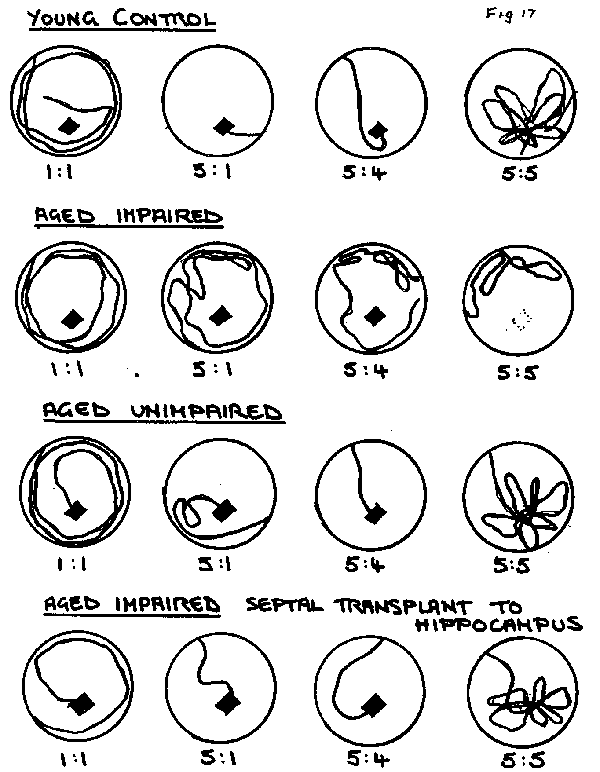
In the above experiment an attempt was made to mimic the effects of senile dementia or stroke that lead to degeneration of the septal neurones innervating the hippocampus by introducing a lesion into the hippocampus. However it is now possible to distinguish aged rats that suffer from a form of senile dementia from those that do not; the former have a natural loss of septal neurones as a consequence of the dementia. The method used to distinguish rats with senile dementia from those that do not suffer from this complaint involves placing rats in a water tank of the kind shown in figure 16. Rats don't like being forced to swim around in a tank any more than we do so a little stand is placed about an inch under the water, which is opaque so that the rat cannot see the stand; as the rat swims around its feet sometimes bump into this little stand and not being stupid it sits on the stand, rests, and looks around the room. We can trace the movements of the rat in the water before it finds the stand using a TV camera elevated above the trough which is shown in figure 16. In this way the actual locus of movement of the rat in the water before it sits on the stand can be followed, as shown in figures 16 and 17. The rat knows it's position in the water because it can see the interesting objects in the room, such as the clock etc, so that it can form a spatial map of the room in its hippocampus as was described above in relation to the T-maze. When the rat forms this map it has the coordinates of the stand with respect to the spatial layout of the objects in the room.
 |
 |
| Figure 16. The Morris water tank used to determine the spatial memory of rats. The water tank is placed in about the middle of the room. It contains opaque water and a stand (shown in the cut-away of the tank wall) which is about one inch beneath the surface of the water; this is sufficiently deep for the rat not to see it when swimming in the tank so that it only becomes aware of the stand if its, feet come in contact with it. Surrounding the tank are objects on the wall, such as curtains, clocks and potplants (and a large picture of other rats) which allow the swimming rat to determine its' orientation; the spatial location of the rat in the water tank is laid down as a spatial memory in the hippocampus and this allows a healthy rat to determine the position of the unseen stand with respect to the objects in the room, once its' feet have- come in contact with the stand.. A television camera is placed above the water tank which allows 'the operator at the television computer terminal shown to monitor the locus of the swimming pathway of the rat on::e it has been placed in the tank at an arbitrary position. |
Figure 17. The locus of the swimming pathway of rats (determined by the methods given in the legend to figure 16) after they have been placed in the Morris water tank. The view is looking down on the tank, and shows the position of the stand beneath the opaque water in the tank. Each row shows the results for series of trials which determined if a rat found the stand (and then sat on it) during a 5 minute period; there were five trials on each of five successive days and the results are shown for the first trial on the first day (1.1), the fifth trial on the first day (5.1), the fifth trial on the fourth day (5.4) and the fifth trial on the fifth day (5.5). In the first row a young control rat (about 6 months old) was placed at a random site in the tank at 1.1 and left to swim; it will be noted that at 1.1 the rats feet did not accidently make contact with the stand; by 5.1 this had happened and the spatial memory system, of the hippocampus had located the position of the unseen stand with respect to the objects in the room enabling the rat to swim directly to the stand and sit on it, as shown; this also occurred at 5.4; at 5.5 the stand was removed and the rat swam repeatedly over the site where the site had been, seeking a rest. In the second row an Aged Impaired rat (about 3 years old) is shown to be unable to lay down a spatial memory of the position of the stand, even though its' feet accidently come in contact with it several times over the 25 trials. In the third row an Aged Unimpaired rat (again about 3 years old) is shown to be able to lay down a spatial memory as well as the Young Control rat, ancl performs in a like manner. The final row shows an Aged Impaired rat that had a transplant of embryonic neurones from the septum in its' hippocampus; the locus of the swimming pathway of the rat in each case shows that it has formed a spatial memory of the stand as quickly as the Young Control. |