
2009年3月6日,《细胞》(Cell)网络版提前在线发表了中国科学院神经科学研究所蒲慕明研究员与段树民研究员合作的最新研究成果。该研究首次发现神经元轴突起始段(AIS)存在一种由肌动蛋白(F-actin)和Ankyrin G构成的分子筛结构,能够选择性地控制不同蛋白在轴突与胞体树突间的运输,从而维持神经元极性。这一发现为理解神经元的蛋白极性分布机制提供了全新视角。
蒲慕明现任神经科学研究所所长,其研究团队长期致力于神经环路的可塑性以及大脑发育机制的研究。本研究的共同通讯作者为蒲慕明研究员与段树民研究员,第一作者为两位研究员联合指导的博士生宋瑷宏。
神经元是高度极化的细胞,以轴突起始段为界,分为轴突和胞体树突两部分。树突负责接收传入信号,轴突负责传出信号。这种功能不对称依赖于不同蛋白在轴突和树突上的非对称分布。然而,这些极性分布如何建立并维持,一直是神经生物学的重要问题。本研究发现,在接近胞体的轴突起始段存在一个由肌动蛋白和Ankyrin G构成的“分子筛”,如同滤网一样限制大分子蛋白在轴突和胞体之间的自由扩散,但允许某些依赖特定马达蛋白转运的膜蛋白通过。
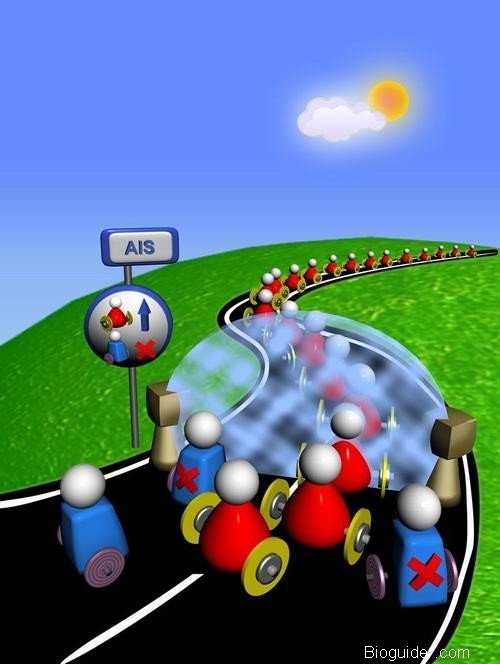
进一步研究表明,马达蛋白驱动力的强弱以及膜蛋白-马达蛋白复合体运输效能的高低,是决定膜蛋白能否通过AIS分子筛的关键因素。轴突膜蛋白转运复合体VAMP2-KIF5的运输效能较高,能够穿过AIS分子筛从胞体转运至轴突;而树突膜蛋白转运复合体NR2B-KIF17和GluR2-KIF5的运输效能较低,无法穿越这一胞浆屏障。这一新颖的机制为神经元蛋白的极性分布研究提供了重要理论基础。
该研究论文的英文摘要如下:
“Distinct molecules are segregated into somatodendritic and axonal compartments of polarized neurons, but mechanisms underlying the development and maintenance of such segregation remain largely unclear. In cultured hippocampal neurons, we observed an ankyrin G- and F-actin-dependent structure that emerged in the cytoplasm of the axon initial segment (AIS) within 2 days after axon/dendrite differentiation, imposing a selective filter for diffusion of macromolecules and transport of vesicular carriers into the axon. Axonal entry was allowed for KIF5-driven carriers of synaptic vesicle protein VAMP2, but not for KIF17-driven carriers of dendrite-targeting NMDA receptor subunit NR2B. Comparisons of transport rates between chimeric forms of KIF17 and KIF5B, with the motor and cargo-binding domains switched, and between KIF5 loaded with VAMP2 versus GluR2 suggest that axonal entry of vesicular carriers depends on the transport efficacy of KIF-cargo complexes. This selective AIS filtering may contribute to preferential trafficking and segregation of cellular components in polarized neurons.”
该研究后续产生了广泛影响,AIS分子筛的概念被拓展至多种神经系统疾病的研究中,如阿尔茨海默病、肌萎缩侧索硬化症等,揭示了极性运输异常与神经退行性变之间的关联。
蒲慕明代表性作品:
- Requirement of TRPC channels in netrin-1-induced chemotropic turning of nerve growth cones. [G.X. Wang, and M-m. Poo (2005) Nature 434, 898-904]
- Rapid BDNF-induced retrograde synaptic modification in a developing retinotectal system. [J. Du, and M-m. Poo (2004) Nature 429, 878-83]
- Reversal and stabilization of synaptic modifications in a developing visual system. [Q. Zhou, H. Tao, and M-m. Poo (2003) Science 300, 1953-57]
- Moving visual stimuli rapidly induce direction sensitivity of developing tectal neurons. [F. Engert, H.W. Tao, L.I. Zhang, and M-m. Poo (2002) Nature 419, 470-475]
- Adaptation in the chemotactic guidance of nerve growth cones. [G. Ming, S.F. Wong, J. Henley, X. Yuan, H. Song, N.C. Spitzer, and M-m. Poo (2002) Nature 417, 411-418]
- Neurotrophins as synaptic modulators. [M-m. Poo (2001) Nature Reviews Neurosci. 2, 24-32]
- Synaptic modification by correlated activity: Hebb's postulate revisited. [G. Bi, and M-m. Poo (2001) Annu. Rev. Neurosci. 24, 139-166]
- GABA itself promotes the developmental switch of neuronal GABAergic transmission from excitation to inhibition. [K. Ganguly, A. Schinder, and M-m. Poo (2001) Cell 105, 521-532]
- Calcium signaling in the guidance of nerve growth by netrin-1. [K. Hong, M. Nishiyama, J. Henley, M. Tessier-Lavigne, and M-m. Poo (2000) Nature 403, 93-98]
- Distributed synaptic modification in neural networks induced by patterned stimulation. [G. Bi and M-m. Poo (1999) Nature 401, 792-796]
- Gating of BDNF-induced synaptic potentiation by cAMP. [L Boulanger, and M-m. Poo (1999) Science 284, 1982-1984]
- A critical window in the cooperation and competition among developing retinotectal synapses. [L. Zhang, H-z. Tao, C. Holt, W. Harris, and M-m Poo (1998) Nature 395, 37-44]
- Propagation of activity-dependent synaptic depression in small neural networks. [R. Fitzsimonds, H-j. Song, and M-m Poo (1997) Nature 388, 439-448]
- A cAMP-induced switching of turning direction of nerve growth cones. [H. Song, G. Ming, and M-m. Poo (1997) Nature 388, 275-279]