
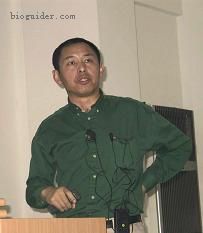
韩珉教授:
上海人。74年插队到安徽。78年考到北大生物系,82年毕业并入选CUSBEA留美项目,83年赴美国“洋插队”,落户到UCLA加州大学洛山矶分校随Michael Grunstein教授学习,88年获得博士学位(酵母中的基因调控)。88年-91年在CALTEC加州理工大学Paul Sternberg教授实验室做博士后(采用线虫做发育研究)。1991年到卡罗拉多boulder执教,先后任卡罗拉多大学助理教授、副教授、教授。1997年被遴选为著名的休斯医学研究所研究员。
Summary Research Projects/Interests of Min Han's Laboratory
The Han laboratory uses Caenorhabditis elegans as a model system to study the mechanisms of cell differentiation, organ morphogenesis, and lipid metabolism.
Cell differentiation, organ morphogenesis, and lipid metabolism in C. elegans.
Due to its genetics accessibility and our knowledge of its cell lineage, anatomy, and the entire genome sequence, the nematode Caenorhabditis elegans has been a powerful model system for studying many mainstream biological problems including those closely related to human diseases. Research in our laboratory had initially focused on understanding the mechanisms controlling the development of the egg-laying organ, vulva, in the worm. However, in recently years, we have extended our effort to address interesting questions in other areas.
I. Signal Transduction in Controlling Vulval Differentiation
Cell-cell communication plays a key role in directing cells to differentiate during animal development. Vulval induction in C. elegans hermaphrodite is controlled by multiple cell signaling and regulatory pathways. Activities of a conserved RTK/RAS/MAPK signal transduction pathway induce three epidermal cells to differentiate into vulval tissues. The activity of this signal transduction pathway is antagonized by functions of so-called SynMuv genes that include genes encoding for the homologs of mammalian tumor suppressor RB. Moreover, the LIN-39HOX protein that provides the competence and specificity for vulval precursor cells.
By screening for mutations that suppress the phenotype caused by mutations of ras, researchers in our laboratory have identified many genes that encode either key factors relaying the signals from Ras, or factors positively or negatively modifying the activity of the pathway. The latter includes seven sur genes. We also collaborated with Dr. Kun-Liang Guan (
To further identify genes acting downstream of the signaling pathway and genes involved in the execution of vulval differentiation, we have conducted additional suppressor screens. Five new genes have been identified and cloned. Genetic and biochemical functions of these genes are being analyzed.
Grants from NIH provided support for above projects.
II. Defining synthetic interactions with specific tumor suppressor genes
Genetic redundancy by structurally related or unrelated genes is an impediment for biologists seeking to determine gene functions through genetic approaches. We have designed a screen and isolated single mutations in seven different genes that synthetically interact with a null lin-35 (homolog of the mammalian Rb tumor suppressor) mutation, which has no obvious phenotype on its own. Analysis of some of these genes has indicated that in conjunction with some of these genes, lin-35/RB regulates cell proliferation, organ morphogenesis, and larval growth/development. In addition, we have recently carried out an RNAi-mediated genome-wide synthetic screen using a daf-18 (homolog of the mammalian Pten tumor suppressor) mutation to identify genes that act with it in previously unknown biological processes. This screen uncovered more than 30 genes that may act with daf-18 for various developmental functions.
III. Cell Differentiation, Fusion, and Migration
Hypodermal cell differentiation during postembryonic development is an excellent model system to study the mechanisms of a number of basic cellular processes involved in organ morphogenesis. For example, 11 hypodermal P cells go through cell migration, fusion, and divisions to form correct patterns during larval development. In our genetic screens, we have identified a number of genes that act in those cellular processes.
Cell divisions. By characterizing mutations that disrupt vulval morphology, we have analyzed the roles of a number of genes involved in cell division and explored the links between cell cycle control and morphogenesis. For example, we have determined that the worm evl-20 gene encodes the functional homolog of human ARL-2 and acts to regulate cytoskeleton dynamics during cytokinesis and hypodermal cell movement during development.
Cell fusion and cell shape. We have identified a number of mutations that cause defects in cell fusion and cell shape formation. Through analysis of temperature sensitive mutations, we have shown that nhr-25, a nuclear receptor gene, interacts with a hox gene to regulate hypodermal P cell and seam cell fusion events. A biochemical assay suggests that NHR-25 directly binds to LIN-39HOX. We have also shown that several cog genes function to promote proper fusion events or to specify proper morphology of vulval cells. Addition cell fusion mutations are being analyzed.
Cell migration. We have also analyzed the role of